
This is an extract from an op-ed co-authored by Social Change Lab's Cathy Rogers, alongside Saul Levin (Center for Nonviolent Conflict Research) and Philip Eubanks (Climate Emergency Fund), first published in Waging Nonviolence on 23 July 2026.
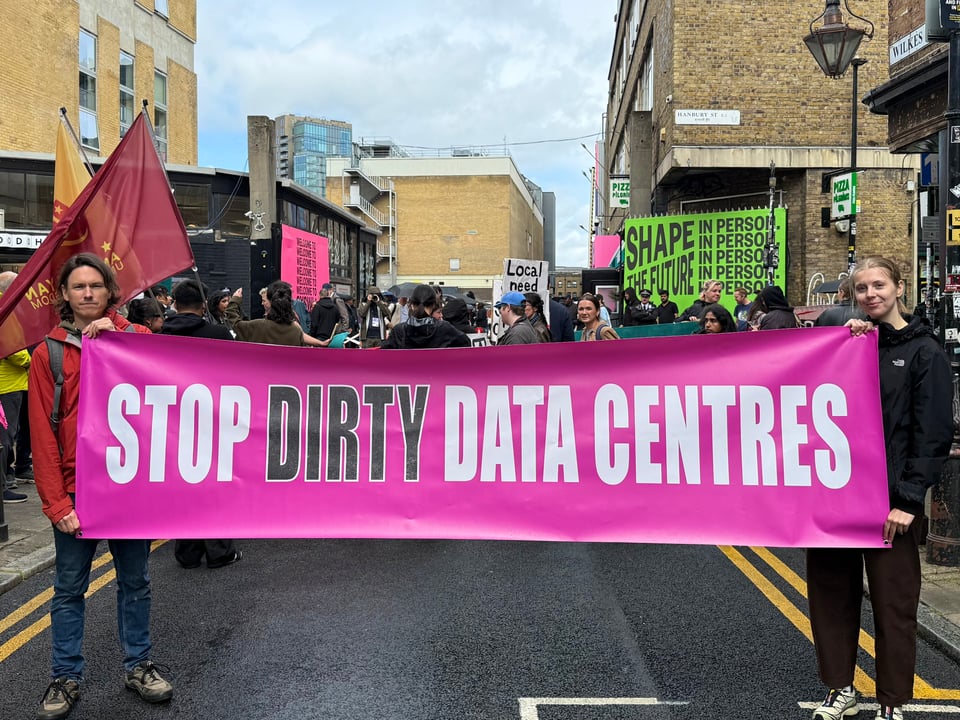
Earlier this year, Gallup asked a national sample of Americans whether they would support an AI data center being built in their local area. Seventy-one percent opposed it, 48 percent of them strongly. Opposition to living near a nuclear power plant was markedly lower, at 53 percent. Republicans, Democrats and independents all rejected data centers. Asked why, respondents most often pointed to environmental concerns: water, energy, land use, noise and air pollution — and the lack of community consent.
At Social Change Lab we recently ran a randomized controlled trial with 3,467 participants to answer a question the AI accountability movement has been wrestling with: Which of AI’s many harms actually move people from concern to action? We tested 11 different arguments, from environmental effects to job losses and the harms of algorithmic bias; from AI enabling more pervasive surveillance to the risk of superintelligent AI leading to human extinction.
The results showed that AI’s environmental impacts were the strongest predictor of willingness to act. Job displacement — the issue people mention most unprompted, ranked much lower. Extinction risk came last. And the emotion most strongly associated with action was not fear or anxiety, but anger.
These findings should concentrate the minds of climate organizers and funders alike. Data centers have become a focal point for public anger not just over AI but over climate policy around the world. Unlike abstract metrics such as “CO2 parts per million,” every data center is tangible; it requires a planning application, a zoning decision, a water permit and elected officials willing to approve — or reject — it. These local decisions create concrete opportunities for organizing.
In the United States, the movement to halt data centers has grown with remarkable speed: The New York State Assembly recently passed what could become the country’s first statewide moratorium; Seattle became the largest American city to adopt one after residents generated almost one hundred thousands emails to the city council; and more than 500 organizations from 47 states have joined the Stop Data Centers Coalition.
But the movement is growing far beyond the United States.
Read the full piece on Waging Nonviolence to learn more about how a tiny Dutch town beat Meta, the lessons from Ireland's data centre battle, the water fights in Chile and Uruguay, and what funders can learn from these patterns.
Read the full op-ed →
All the very best,
Social Change Lab
You just read an issue of Social Change Lab. You can also browse the full archives of this newsletter.