We surveyed 415 campaigners about tougher protest laws. Here's what we found
Our new survey with Fossil Free London finds protest participation is up overall, but tougher laws are narrowing who protests and how.
SOCIAL CHANGE LAB 30 SEPT
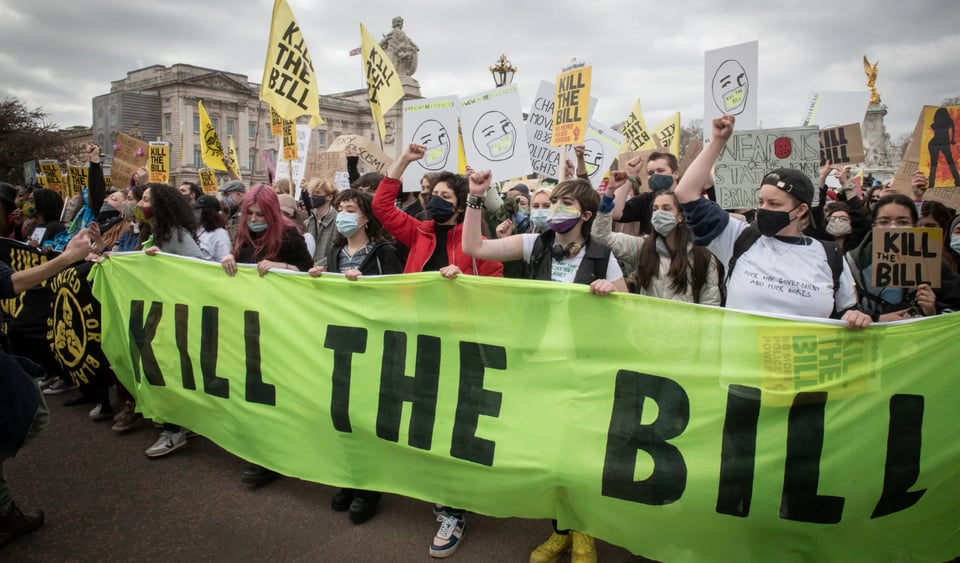
Protesters at a Kill the Bill march in April 2021. Image: Extinction Rebellion
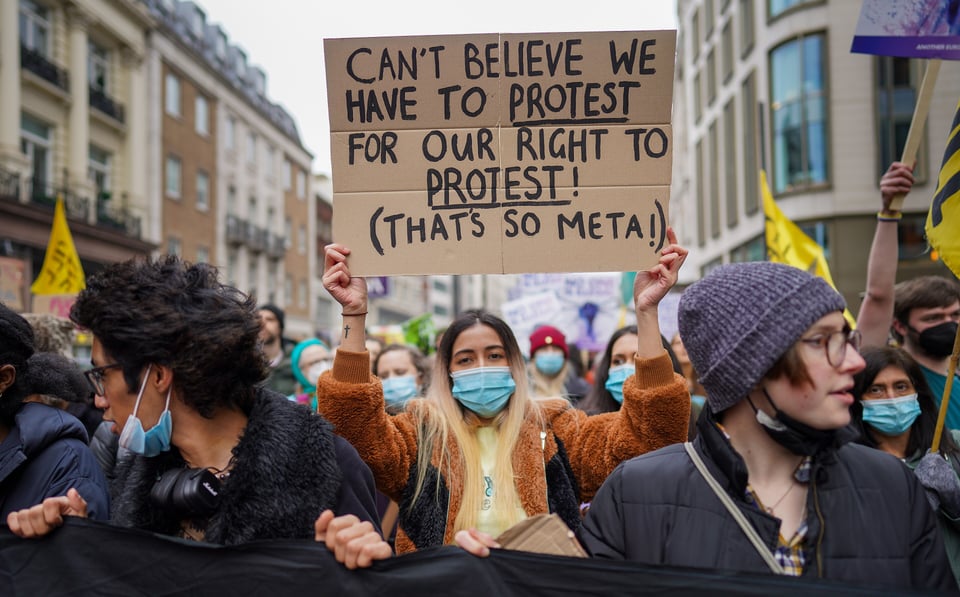
Over the past few years the legal environment for protest in England and Wales has been radically reshaped. We have seen the Police, Crime, Sentencing and Courts Act 2022, the Public Order Act 2023 and the National Security Act 2023, and more recently changes to the use of terrorism powers following the proscription of Palestine Action. NGOs, campaigners and others have been shocked by the changes. Scrutinising the Public Order Bill, parliament’s own Joint Committee on Human Rights warned it risked a “chilling effect on the right to protest”. The UN said much the same. There is real concern about silencing protest. But a competing body of research - which academics call the ‘repression paradox’ - suggests the opposite: that legislation which unjustly clamps down on peaceful protest can backfire, swelling the numbers rather than shrinking them.
To find out what has happened in the UK, we teamed up with Fossil Free London to survey 415 UK campaigners and activists earlier this year.
Read our findings below, or join our webinar on Thursday 15 October (17:00-18:00 BST), where we'll share insights from this and other new research.
Image by Cory Doctorow, 2017, CC BY-SA 2.0. Palantir pavilion, World Economic Forum, Davos, Switzerland
We’ve been hearing a lot lately about the risks of superintelligent AI wiping out humanity. The resignation of Jacob Coxon from Anthropic triggered a worldwide debate about the perils of models that AI companies are developing. But many people are much more concerned about the AI harms that are already here - and ballooning in front of our eyes. Some even argue that the doomsday scenarios of the ‘X-riskers’ are a deliberate distraction from the very real and actual dooms of today.
Enter the nurses. Perhaps at first glance unlikely messengers for a movement contesting AI. But nurses and health workers in the US, the UK and increasingly around the world are loudly voicing their concerns about AI - and particularly Palantir-shaped AI - in health care. The specific concerns about Palantir vary from country to country - in the UK, it’s about handing over sensitive patient data, elsewhere it is immigration enforcement or military contracts. What is consistent across all of them is the uneasy feeling that Palantir represents exactly the sort of AI company decent people should not do business with.
Since 2022, UK authorities have gained extensive new powers to limit protest. How have the introduction of these measures affected activists and campaigners, and how does the wider public feel about the changes? Over four in five people in Britain say everyone should be able to protest on issues they care about, so how do we turn that passive majority support into something more vocal?
Social Change Lab and Fossil Free London are hosting a webinar to share insights from our new research looking at what the new laws have done to campaigners' willingness to protest, and which messages move the public to defend protest rights.
Join the webinar on Thursday 15 October17:00 - 18:00 BST (online).
We’re soon going to publish our work on protest rights in the UK. We’ve done two studies: one a survey of activists and campaigners which shows how the context for protest has changed with recent legislative restrictions. The other is an experiment to see how best to talk about protest rights to persuade the general public. We’ll be publishing both in the coming weeks .
As part of the experiment, we asked a few questions about democracy and authoritarianism, since this was a good opportunity to get a read on the views of nearly 3500 people. We were following a hunch that perhaps when campaigners use these terms, the audiences they're speaking to might not have a clear sense of what they actually mean - and that might risk unintended consequences. For example, the word ‘authoritarian’ is easily confused with the word ‘authoritative’ - and perhaps authoritative sounds quite appealing - most people like authoritative voices on subjects they care about.
This is an extract from an op-ed co-authored by Social Change Lab's Cathy Rogers, alongside Saul Levin (Center for Nonviolent Conflict Research) and Philip Eubanks (Climate Emergency Fund), first published in Waging Nonviolence on 23 July 2026.
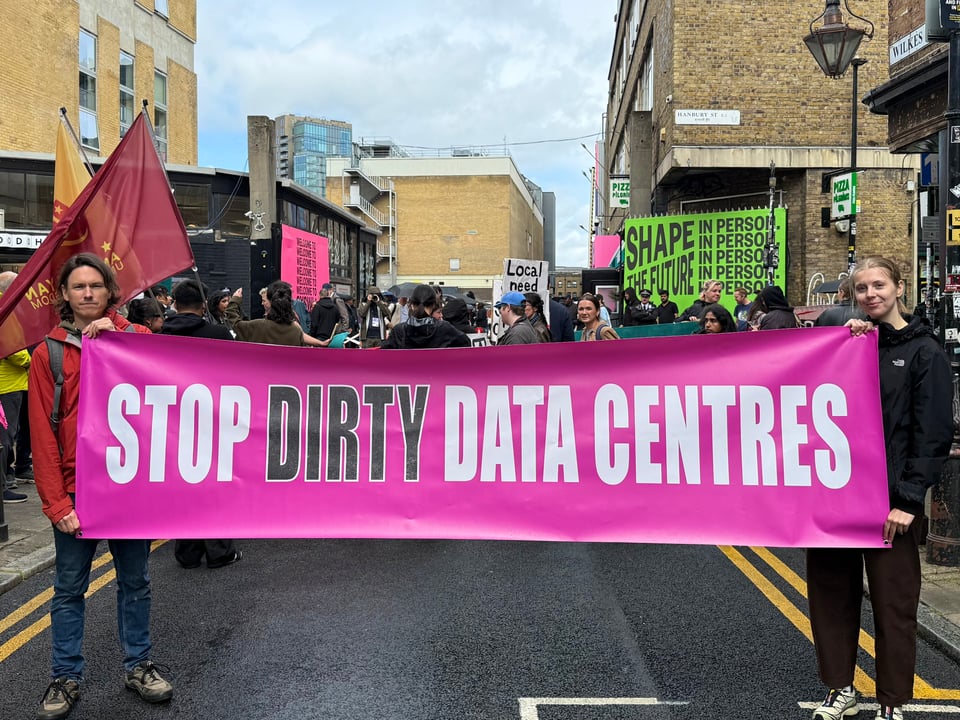
Earlier this year, Gallup asked a national sample of Americans whether they would support an AI data center being built in their local area. Seventy-one percent opposed it, 48 percent of them strongly. Opposition to living near a nuclear power plant was markedly lower, at 53 percent. Republicans, Democrats and independents all rejected data centers. Asked why, respondents most often pointed to environmental concerns: water, energy, land use, noise and air pollution — and the lack of community consent.
At Social Change Lab we recently ran a randomized controlled trial with 3,467 participants to answer a question the AI accountability movement has been wrestling with: Which of AI’s many harms actually move people from concern to action? We tested 11 different arguments, from environmental effects to job losses and the harms of algorithmic bias; from AI enabling more pervasive surveillance to the risk of superintelligent AI leading to human extinction.
It's been a busy few months at Social Change Lab, with new research launching across protest rights and climate, a brand new website, and a chance to join our team. Here's what we've been up to.
Come work with us: applications close this Sunday
We're hiring a Research & Outreach Officer and the deadline is fast approaching (this Sunday, 19 July). If you care about understanding what makes social movements effective and want to help turn rigorous research into real-world impact, we'd love to hear from you. Full details and how to apply are on our careers page. Please do share it with anyone you think might be a good fit.
When Mette Frederiksen won a third term as Denmark's prime minister in March, her new government committed to something remarkable: structural reform of the country's most iconic industry: pig farming. Pork and pig farming are a huge issue in Denmark - everyone has heard of Danish bacon. Denmark rears around 30 million pigs a year, most of them destined for export, using particularly intensive farming practices. So this was a big ask for campaigners. But they succeeded in making this election 'the pig election', drawing mass public attention to the issue of pig welfare. The outcome went beyond campaigners’ demands: deadlines to end tail docking (2030) and extreme breeding (2035), plus commitments to shrink pig production, curb piglet exports and a systemic shift in farming towards organic and regenerative models.
I spoke recently to Britta Riis, director of Animal Protection Denmark (APD), about how it happened - and what aspects of the campaign could be exploited by animal campaigners elsewhere.
I’m excited to share that Social Change Lab is looking for a Research & Outreach Officer to join the team. The role involves working with our two Directors of Research to design and deliver rigorous studies on the effectiveness of social movements, while also getting those findings into the hands of activists, funders and journalists who can act on them.
For those new to Social Change Lab, we study social movements to understand their impact and help them be more effective. We focus on movements working on climate and the environment, animal & vegan advocacy, and AI safety. Our research has been featured in the New York Times, the Guardian and the BBC, and campaigners and funders use it to decide where to focus their efforts.
The details: Salary: £37,000–£42,000 FTE (preference for 0.8 FTE) Location: Remote (strong UK preference) Contract: two-year fixed-term, with potential for extension subject to funding Deadline: 19 July 2026
Apply here, or if you know someone who might be a good fit, please do share this with them!
Thanks and all the very best, Sam Nadel, Executive Director, Social Change Lab