

When Mette Frederiksen won a third term as Denmark's prime minister in March, her new government committed to something remarkable: structural reform of the country's most iconic industry: pig farming. Pork and pig farming are a huge issue in Denmark - everyone has heard of Danish bacon. Denmark rears around 30 million pigs a year, most of them destined for export, using particularly intensive farming practices. So this was a big ask for campaigners. But they succeeded in making this election 'the pig election', drawing mass public attention to the issue of pig welfare. The outcome went beyond campaigners’ demands: deadlines to end tail docking (2030) and extreme breeding (2035), plus commitments to shrink pig production, curb piglet exports and a systemic shift in farming towards organic and regenerative models.
I spoke recently to Britta Riis, director of Animal Protection Denmark (APD), about how it happened - and what aspects of the campaign could be exploited by animal campaigners elsewhere.
Be ready for the trigger
The proximate trigger was footage. Animal activists secretly filmed in two industrial pig farms. The footage was turned into two documentaries for Denmark's main broadcaster, TV2 in autumn 2025. Crucially, the farms exposed belonged to top figures in the industry - senior people at Danish Crown and the president of the farmers' association among them. The usual big ag defence - that these were ‘just rare cases’ or ‘bad apples' didn’t wash in this case. Animal Protection Denmark reported them to the police.
Documentaries had come before and changed nothing. What was different here was the readiness of campaigners. Two years earlier, Riis had persuaded her board to invest in communications and public affairs staff, so when the footage landed there were people in place to act on it. In January 2026, with the images of pig suffering still fresh in people's minds, they hit the media, got politicians on board, and launched a citizens' initiative which reached the 50,000 signatures needed to force a parliamentary debate within 72 hours.
Trigger events create opportunities, but only for those that are prepared to act quickly. Movements can't schedule these moments, but they can definitely prepare for them (a point made well in Mark and Paul Engler's This Is an Uprising).
“When a trusted, mainstream institution takes to the streets, it signals that something genuinely unusual is happening that the usual means have failed to get results.”
Respectable rebels
When the election was called, campaigners had three weeks. They formed a deliberately loose 'alliance for the pig election' - anyone with an interest could join, and many did: environmental groups, Greenpeace, and residents' groups who live next to industrial farms and have long complained about the smell, the ammonia, the polluted water in rivers. Dirty rivers particularly energised the public: nitrate contamination of drinking wells, worst in the 'nitrate belt' around Aalborg, gave the campaign a constituency well beyond people primarily concerned with animal welfare.
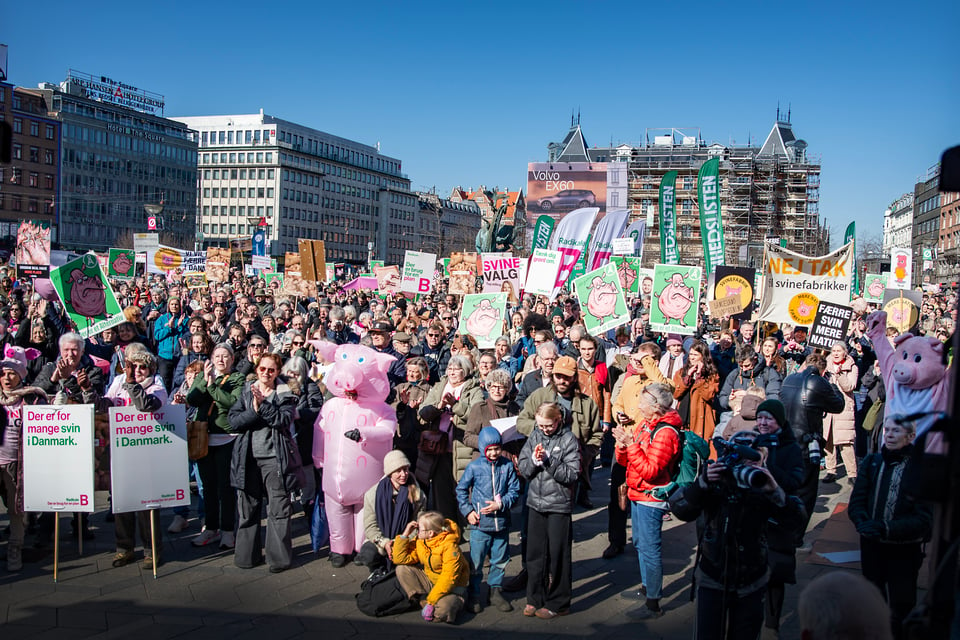
The alliance staged a 5,000-person demonstration - very unusual in Denmark, and all the more striking because Animal Protection Denmark is a 150-year-old, socially conservative organisation. It was like the RSPCA arranging a mass participation protest. Britta thinks their reputation made the difference: when a trusted, mainstream institution takes to the streets, it signals that something genuinely unusual is happening that the usual means have failed to get results.
Give politicians something to say yes to
The campaign didn't stop at public pressure. They placed stories, commissioned polls showing the public cared, and took MPs to organic pig farms so they could see better existing and functional systems working with their own eyes. They then worked with parliamentarians across the spectrum to design policies each party could own. Even parties on the right, not natural allies, engaged once the public momentum was visible.
It worked beyond expectations. The campaign had four demands: an end to farrowing crates, more space and rooting materials for pigs, an end to tail docking, and an end to extreme breeding. They got all of that, plus structural commitments on the size and shape of the industry itself.
Facts can be a powerful vaccine against misinformation
Ask Riis what mattered most and her answer is disarmingly practical: the right staff, connections inside government, and a well-informed public. On that last point she was emphatic. By election time, people knew so much about the pig industry that big ag’s spin machine simply broke down. 'Facts, facts, facts', as she put it - are the best way of vaccinating the public against lies.
This chimes with our own research. Social Change Lab recently surveyed UK and US publics on factory farming for Project Slingshot (a campaign against factory farming of which Riis, it turns out, is a fan). We found big gaps between what people think happens on farms and what actually does - and, crucially, that the more accurately people understand real practices, the more strongly they oppose them. Knowledge is more than a nice-to-have; sometimes it’s the key leverage.
And the honest caveats
Riis is clear-eyed about limits. Implementation now rests on a six-month negotiation between government, agribusiness, farmers, unions and welfare groups - though with a backstop: if talks fail, the government legislates anyway. And so far, supermarket behaviour hasn't budged; people haven’t suddenly stopped buying bacon. Our survey found the same disconnect - evoking disgust is easy; convincing people to change what they buy is much harder. Perhaps in Denmark’s case it is especially unsurprising; 90% of Danish production goes overseas. And, as in many countries, the information on packaging about animal welfare is not clear; some evidence suggests that when people are given more accurate information, they are prepared to pay more for higher welfare options. Changing consumption might take longer - but what is clear is that people want governments and regulators to take animal welfare seriously.
Denmark is a small country with high trust in government institutions,and has a strong citizens' initiative tradition, so not all of this transfers. But preparation, coalition breadth, credible messengers and a fact-armed public - those travel anywhere.
All the best,
Cathy Rogers
Director of Research & Development, Social Change Lab

You just read an issue of Social Change Lab. You can also browse the full archives of this newsletter.